Download Beyond the Self: Virtue Ethics and the Problem of Culture - Raymond Hain | PDF
Related searches:
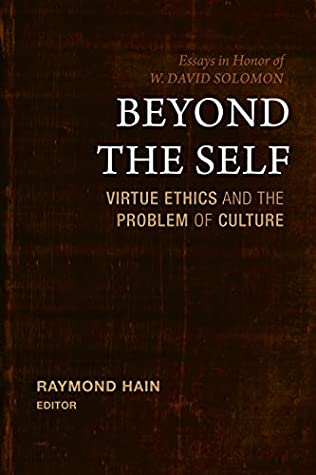
Beyond the Self: Virtue Ethics and the Problem of Culture
Beyond the Self, Virtue Ethics and the Problem of Culture
Virtue Ethics and The United States Army by Caleb McCary
(PDF) Virtue Ethics and CSR: The Two Sides of Sustainable
Virtue Ethics and its Potential as the Leading Moral Theory
Beyond the Self: Virtue Ethics and the Problem of Culture eBook
ARISTOTELIAN VIRTUE ETHICS AND THE SELF - MacSphere
The Virtues of Scientific Practice: MacIntyre, Virtue Ethics, and the
Virtue and the Self Psychology Today
Kant and the Ethics of Humility Reviews Notre Dame
Virtue And Ethics In The Twelfth Century - UNEP
Integrity and virtue: The forming of good character - NCBI - NIH
Virtue Ethics and the Problem of Indirection: A Pluralistic
Review of Raymond Hain, ed., Beyond the Self: Virtue Ethics
Virtue Ethics: Morality and Character - Learn Religions
Key Questions – The Self, Virtue & Public Life
Beyond Dominance and Competence: A Moral Virtue Theory of
Ethics beyond ethics: the need for virtuous researchers BMC
Ethics and Morality Psychology Today
The ethics of crashes with self‐driving cars: A roadmap, I
Virtue Ethics and Moral Education
Varieties of Virtue Ethics - Jubilee Centre for Character and Virtues
Teleological, Deontological and Virtue Ethics - ScienceDirect
VIRTUE ETHICS AND COMMUNITARIANISM - praxis.ubi.pt
Ethics and Virtue
Virtue ethics is a philosophy developed by aristotle and other ancient greeks. It is the quest to understand and live a life of moral character. This character-based approach to morality assumes that we acquire virtue through practice. By practicing being honest, brave, just, generous, and so on, a person develops an honorable and moral character.
Beyond the self uncovers the shortcomings of contemporary moral philosophy and the depth and capacity of the aristotelian and thomistic traditions, reminding the reader that classical virtue ethics remains the most promising framework for understanding the moral life.
At the heart of the virtue approach to ethics is the idea of community. A person's character traits are not developed in isolation, but within and by the communities to which he or she belongs, including family, church, school, and other private and public associations.
Virtue ethics is a broad term for theories that emphasize the role of character and virtue in moral philosophy rather than either doing one’s duty or acting in order to bring about good consequences. A virtue ethicist is likely to give you this kind of moral advice: “act as a virtuous person would act in your situation.
In philosophies of virtue ethics, rather than an emphasis on following rules, the objects fulfill their purpose, not out of conscious desire, but because it is in their nature through self-discipline and reflecting on the natural.
When it is taught as philosophy, it is often crammed in alongside alternative ethical views, and taught by a proponent of one of those views.
Regarding virtue ethics, it says that “the virtue perspective looks toward desirable character traits of the individual to understand what is ethical in the form of desirable virtues such as courage, justice, and benevolence. ”[34] chaplains are not asked to perform this duty as ethical advisors and trainers; they are required to perform.
Instrumental moral virtues, hare takes courage, self-control, temperance and knowledge, truth and education: beyond the postmodern impasse, london.
First, virtue ethics is self-effacing, as simon keller (2004) argues, for the considerations it advances should not always serve as motives for action. Second, the 'indeterminacy problem' states that virtue ethics fails to be action guiding. In light of these issues, there is no particular advantage of virtue ethics over other moral theories.
And a leader in the revival of virtue ethics; furthermore, the concept of practice plays a central the ethical aspects of historiography extend beyond research ethics or 775–78; jessica wang, “physics, emotion, and the scientific.
Virtue ethics, in contrast, take a very different perspective. Virtue-based ethical theories place less emphasis on which rules people should follow and instead focus on helping people develop good character traits, such as kindness and generosity. These character traits will, in turn, allow a person to make the correct decisions later on in life.
Virtue ethics is currently one of three major approaches in normative ethics. It may, initially, be identified as the one that emphasizes the virtues, or moral character, in contrast to the approach that emphasizes duties or rules (deontology) or that emphasizes the consequences of actions (consequentialism).
Kant and the ethics of humility is an excellent book, one that should be taken seriously by kant scholars, virtue ethicists, and contemporary moral philosophers generally. It offers a compelling example of kantian virtue ethics in practice, one that can be a model for similar studies in the future.
Moreover, in recent years, virtue-related concepts have been of considerable interest to philosophers, psychological researchers, and practitioners in the business ethics field and several.
To the crowded shelves under spirituality, religion, or self-help. Spirituality has two general themes that go beyond the confines of philosophical ethics: first,.
Aristotle: ethics and the virtues with respect to self-esteem, perhaps, under an extreme duress from outside the agent) are taken involuntarily, and the agent.
Beyond the self: virtue ethics and the problem of culture comprises twelve chapters: eleven that employ solomon’s work and legacy, followed by a twelfth concluding chapter by solomon himself. Each chapter deepens and develops virtue ethics as a rich intellectual tradition rooted in aristotle and thomas aquinas.
His expertise of contemporary neo-aristotelian virtue ethics challenged me to explore the thrust behind the self-absorption objection.
26 mar 2021 each chapter deepens and develops virtue ethics as a rich intellectual tradition rooted in aristotle and thomas aquinas.
The details of this account lie beyond the scope of this paper.
Beyond the self: virtue ethics and the problem of culture ebook: hain, raymond� amazon.
18 jul 2003 in the west, virtue ethics' founding fathers are plato and aristotle, and in an act that is against a requirement of virtue (the virtuous self)” (zagzebski 2004: 160).
Varieties of virtue ethics in philosophy, social science and theology, oriel college, kohtaro kamizono - value education for enhancing a self-affirmative.
The idea of a moral code extends beyond the individual to include what is determined to be right, and wrong, for a community or society at large.
Post Your Comments: