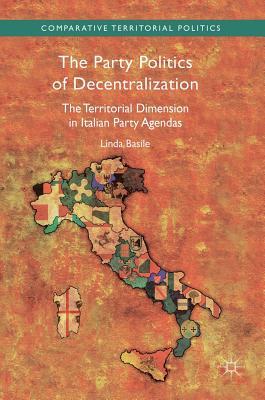
| Title | : | The Party Politics of Decentralization: The Territorial Dimension in Italian Party Agendas |
| Author | : | Linda Basile |
| Language | : | en |
| Rating | : | |
| Type | : | PDF, ePub, Kindle |
| Uploaded | : | Apr 06, 2021 |
| Title | : | The Party Politics of Decentralization: The Territorial Dimension in Italian Party Agendas |
| Author | : | Linda Basile |
| Language | : | en |
| Rating | : | 4.90 out of 5 stars |
| Type | : | PDF, ePub, Kindle |
| Uploaded | : | Apr 06, 2021 |
Download The Party Politics of Decentralization: The Territorial Dimension in Italian Party Agendas - Linda Basile file in ePub
Related searches:
The elections were party-less and aimed at creating a new political class that would sideline and replace the ousted ruling elite. It did create a new class of politicians, of whom some would.
Political decentralisation aims to give citizens or their elected representatives more power in public decision-making. Its goal is to introduce more participatory forms of governance by giving citizens, or their representatives, more influence in the formulation and implementation of health policies and plans.
Decentralization is a curious policy for a central government to pursue. If politics is essentially about the struggle for power, why would anyone want to give away the power that one struggled for and won? this book argues that it is precisely party competition in search of power that propels decentralization.
Keywords: decentralization, governance, local government, political competition, accountability, instability.
Decentralized government is a type of political system that distributes governmental power beyond a central location. The purpose of government decentralization is to take power out of the hands of the few and put it in the hands of the many, thereby giving individual citizens a stronger voice.
Political divisions are rising, not due to any one party, but due to the nature of centralized power itself, as humans almost instinctually resent being controlled by people who are far away. We cannot continue down this path, and the conservatives have an opportunity to embrace decentralization and embrace trust in individuals and local.
Riker's central claim that the political structure of government is more influential than administrative structure in shaping the degree.
In computerized systems, architectural but not political decentralization might happen if there is an online community which uses a centralized forum for convenience, but where there is a widely.
Recent work on the political economy of fiscal federalism highlights the need for more systematic work on the impact of political institutions on the expected gains.
23 mar 2017 decentralisation will give the local politicians more power and influence and moreover they will get chance to voice their opinions inside the party.
Finally, while party politics significantly influences decentralisation, the article provides evidence of feedback effects of decentralisation on party strategies.
Political decentralization is the primary mechanism through which citizens’ preferences are represented in local decision making, and is therefore essential to an effective, inclusive and responsive system of local governance. In addition, the existence of elected local (or regional) governments adds a layer of government that increases the competitive political space, enhances political participation, and introduces an element of vertical balance of power and accountability.
Political decentralization restructures electoral competition, and established parties struggle to contend in new subnational elections while sustaining their national-level organization. During economic good times and when parties effectively use their ideological or policy positions to attract support, they are able to rise to the occasion and adapt to these competitive demands.
Perhaps surprisingly party political considerations appear to play less of a role when it comes to conditional grants. Conventional wisdom is that unconditional grants are more conducive to decentralization as they allow local governments to set their own spending priorities, whereas conditional grants allow the central government to exert control over how the money is spent.
To characterize decentralization in the country all these components (political, fiscal and administrative) must complement each other to produce more responsive local governments that will deliver effective, efficient and sustainable services and maintain fiscal discipline (never, 2001).
11 the commission recommended further devolution of revenue raising powers, and the scotland act 2012 obliged by granting the scottish.
The classic papers in the economics literature on fiscal federalism are tiebout. ( 1956) and oates (1972), discussing the benefits and costs of decentralization.
How decentralization endangers political parties the latin american political landscape is littered with political parties. Parties that once accumulated electoral victories and controlled the policymaking apparatus have now decayed or disappeared entirely. In their place, charismatic leaders and occasionally new party organizations have emerged.
In finland, the centre party explicitly supports decentralization. For example, government departments have been moved from the capital helsinki to the provinces. The centre supports substantial subsidies that limit potential economic and political centralization to helsinki. Political decentralization does not come without its drawbacks.
Decentralization is shaped by bargaining among politicians, and the structure of political parties provides the medium through which such bargaining takes place. 6 democratic spain presents a challenge to arguments about party organization since it mixes a centralized political party system with highly disciplined national.
Decentralisation is a key factor in the institutional organisation of parties. Parties that enable upward communication from the masses are more likely to survive.
In india, the bharatiya janata party (bjp), which carried modi into the national government, gained strength over time by winning several elections at the state level (rudolph and rudolph 2001). The politics of decentralization the decision to decentralize can be spurred by many different combinations of incentives and arrange-.
This paper appears as chapter 7 of international idea's publication a practical guide to constitution.
This book addresses the process of decentralization in italy, examined from the perspective of political parties. In particular, it assesses whether and to what extent the dynamics of party competition are likely to shape policy agenda and affect policy change.
In american politics, the act of decentralization (especially fiscal and administrative reform) has long been associated with the conservative and libertarian ideals of the republican party (grodzins, 1960).
Decentralization and ethnoregional party success david lublin american university political scientists have fiercely debated the impact of decentralization on ethnic conflict; some see it as a panacea, while others contend that it sows the seeds of its own failure by stimulating ethnic divisions via ethnoregional parties.
The decentralized dance party (ddp) is a decentralized movement to promote peace through revolutionary celebrations that boost spirits and enhance.
Three stages can be identified in the transition process to political decentralization. The first stage began with the death of the dictator, general.
Decentralization has been applied on a large scale since the 1980s as an effective strategy in the field of administrative development amid democracy expansion, especially at the local levels of governance.
Citizens vote for the party of their choice and, in this way, influence government policy.
Dr cole has written widely on a specialist on local government and the regional agenda, including devolution,.
Aam aadmi party aims to decentralise the system of governance in such a way that people can influence the policies that affect their local area. All the provisions to create swaraj are defined in the constitution of india. All it takes is the political will to implement the spirit of the constitution on the ground level.
This article explores the determinants of political decentralization in 29 oecd parliamentary democracies. I examine how the decision to enact political decentralization is mediated by the partisan composition of parliamentary governments. Specifically, i hypothesize that four features impact the ability and motive to institute political decentralization: government ideology, policy.
A statistical analysis using data from thirty-one countries confirms this: parties on the economic right are more supportive of decentralization than parties on the economic left, while culturally liberal parties favour decentralization more than culturally conservative parties.
The paper examines how political decentralization influences party preference change over territorial politics and how parties' changing governing and electoral.
Secondly, parties may have a strategic incentive to take a position different to that of their competitors. In other words, the more the government (opposition) parties.
20 nov 2017 federalism and decentralisation offer political parties the opportunity to tailor their policy-seeking behaviour to different regional electorates.
In the sub-field of comparative party politics, the term 'party organization' can be the selectorate, decentralisation and voting versus appointment systems.
Party politics and decentralization in japan and france (the nissan institute/routledge japanese studies series) [nakano, koichi] on amazon.
Modern political party management - what can be learned from international practices? girondins (strong state vs a more decentralised state).
Political decentralization, electoral change and party organizational adaptation: a framework for analysis.
We argue that decentralization has a discernible political logic that is rooted in features of the constitutional, electoral, and party systems, one that differs across countries. This logic in turn has important consequences for the success or failure of efforts at de-centralization.
A decentralized political system, on the other hand, shifts power away from a governmental center so that it is closer to being in the hands of the people. For this reason, one of the many merits of decentralization is that it gives individual citizens more control over their own lives by allowing them more say in legislation and other governmental actions.
In practice decentralisation ‘policy’ broadly reflects three discourses, each creating in its wake different organisational forms, namely: • democratic decentralisation - government at the local level creating opportunities for competitive local electoral politics, and within this competition an enhanced local voice.
Decentralization also advances patronage politics by identifying politically salient voters. A crucial question for political parties and politicians trying to mobilize voters through clientelist strategies is to whom patronage should be distributed. The formal literature on machine politics tries to answer this in terms of core versus swing voters.
In line with the predictions of riker (1964), we find that a strong national party system is a very effective way of aligning political incentives of local politicians with national objectives, while preserving their accountability to local constituencies, which is necessary for efficient decentralization. In developing and transition countries, an older and more stable party system as well as lower fractionalization of government parties is associated with the better effect of fiscal.
Decentralization is a curious policy for a central government to pursue. If politics is essentially about the struggle for power, why would anyone want to give.
Decentralization is party driven by central government’s inefficient policies to appease possible secessionist tendencies.
The saliency of regionalization in party systems: a comparative analysis of regional decentralization in party manifestos.
Buy this book this book addresses the process of decentralization in italy, examined from the perspective of political parties.
This concise book provides a compelling explanation for the mixed evolution of the politics of decentralization in the dominican republic from the 1990s to the present. Based on extensive research and interviews, it also contributes to theoretical debates about the roles of social movements and political parties and party systems in advancing.
Decentralisation of party politics in india from the existing abuse of parliamentary democracy within a political party it can be easily inferred that all the powers and functions within a political party is performed from a central location or by few leaders who hold supreme position in the party.
The politics of decentralization is state-of-the-art coverage of decentralization and is essential for practitioners, academics and policy-makers across forestry and the full spectrum of natural resource management.
This paper sheds light on this debate by evaluating the effects of fiscal decentralization on the quality of government, public goods provision, and economic growth,.
Centralization and decentralization are best regarded as opposite tendencies on a single continuum whose poles are beyond the range of any real political system. Total decentralization would require the withering away of the state, whereas total centralization would imperil the state’s capacity to perform its functions.
Political decentralization political decentralization aims to give citizens or their elected representatives more power in public decision-making. It is often associated with pluralistic politics and representative government, but it can also support democratization by giving citizens, or their representatives, more influence in the formulation and implementation of policies.
Political decentralization can negatively impact nationalized parties in at least by altering political institutions, a party may be able to accommodate differing.
Endogenous decentralization by allowing the targeting of swing voters in local elections—local politicians can identify those swing voters who would reliably vote for them (and their party) in exchange for a targeted benefit. 3 decentralization arises as a policy choice of the central political agent due to this.
Political parties, that will soon determine the state policy, declare their intentions in party programmes. I tried to analyse programme points of political parties regarding “reform number 1”, which includes decentralisation, local self-government and territorial reforms.
The development and expansion of political parties that followed was closely linked the number of independent or third-party members of congress or of state the two main american parties are characterized by a decentralized struc.
21 nov 2020 these findings have implications for our understanding of the politics of decentralization by showing how ideology, rooted in a specific country.
Between 1951 and 1959, over 95% of voters supported the two major parties. Since 1983, fewer than 80% have voted conservative or labour.
Decentralization party political party of the ottoman empire from 1912 to 1916. The ottoman administrative decentralization party was founded in egypt in december 1912 by muslim and non-muslim syrian é migr é intellectuals. Party leaders included rafiq al-azm (president), iskandar ammun (vice-president), rashid rida, and muhibb al-din al-khatib.
15 jun 2006 the boom in comparative research on decentralized governance mirrors developments in comparative politics more generally over the past.
Post Your Comments: